Tag: super fine gypsum

  • Treating Salty Irrigation Water with Gypsum

    Treating Salty Irrigation Water with Gypsum

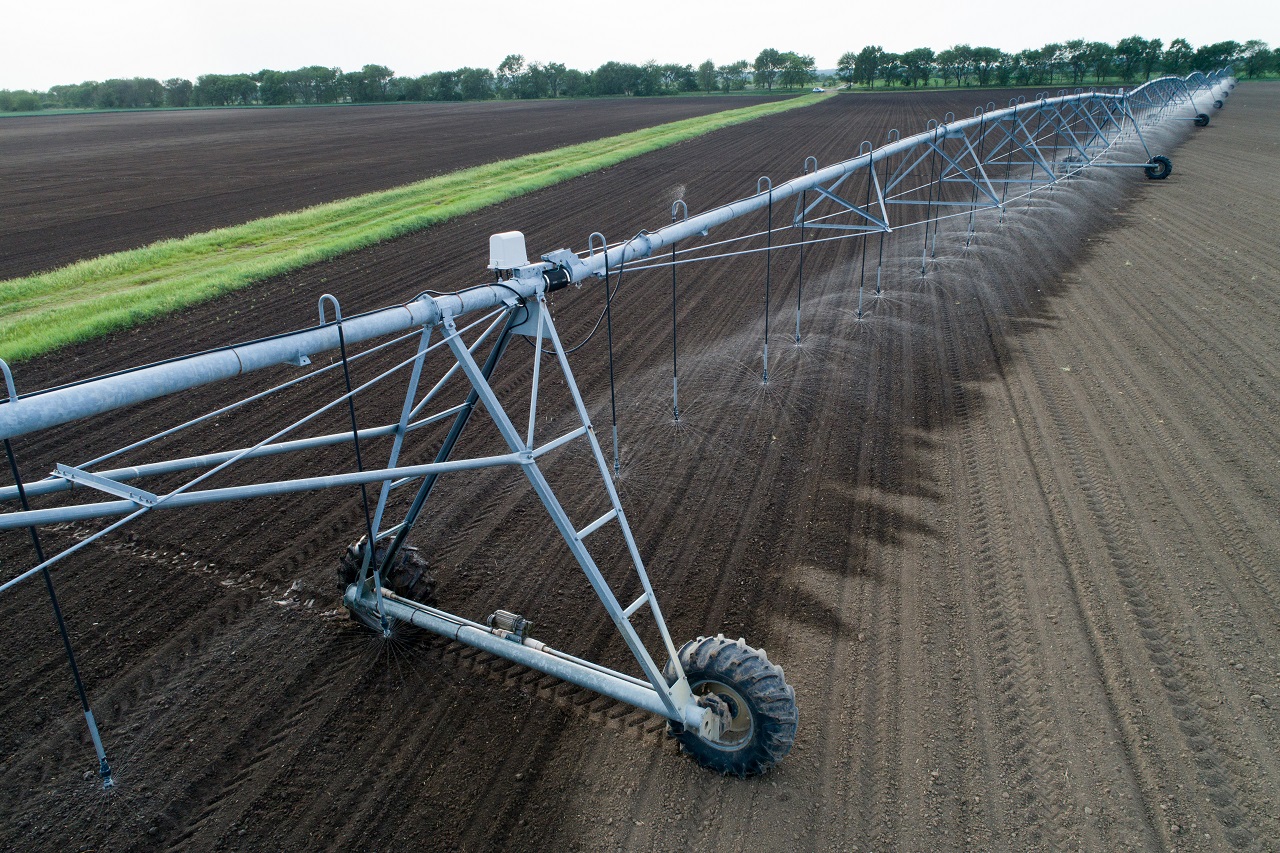
    Gypsum has many uses in agriculture and it can also assist in the treatment of irrigation water for operations such as the coal seam gas extraction.

    Water high in sodium (SAR above 6.0) can be modified through the addition of Gypsum (high in calcium), either through the irrigation water or by direct application to the soil.

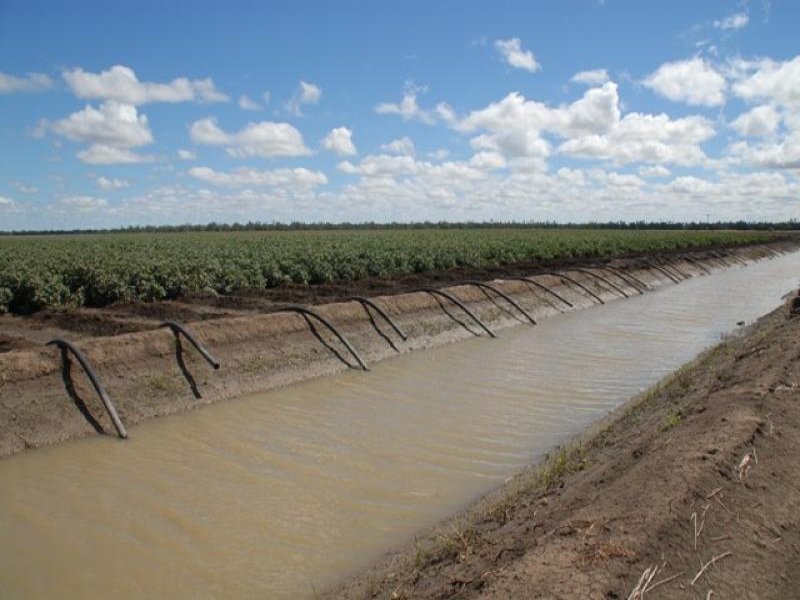
    Certain chemical amendments added to soil or water should improve a low infiltration rate caused by low salinity or by excessive sodium (high SAR) in the irrigation water. Improvement can be expected if the amendment increases the soluble calcium content or causes a significant increase in the salinity (ECw) of the applied water. Amendments are used to help increase the infiltration or counter the effects of sodium, since, at present, there is no economical process available for removing salts or sodium from irrigation water which is low enough in cost for general agricultural use. An amendment, such as gypsum, when added to soil or water will increase the calcium concentration in the water, thus reducing the sodium to calcium ratio and the SAR. Adding gypsum is also beneficial because it increases the salinity of low salt waters, thus improving infiltration (Figure 21). Gypsum of other similar additives will not cause any important improvement if poor infiltration is due to adverse soil texture, soil compaction, restrictive claypan or hardpan layers, or a high water table.

    Water amendments are most effective if the water infiltration problem is caused by a low salinity water (ECw < 0.2 dS/m) or by high SAR in a water of low to moderate salinity (ECw < 1.0 dS/m). If water salinity is moderate to high (ECw > 1.0 dS/m) in addition to a high SAR, soil applied amendments such as gypsum or sulphur may be preferred and often are more effective.

    Example – A 5 hectare area needs an irrigation depth of 100 mm. The gypsum quality is 90% pure and an increase of 2 me/l of calcium is desired in the water. How much gypsum should be used?
    Given: ECw = 0.15 dS/m
    Area = 5 ha
    Gypsum = 90 percent pure
    Total water requirement = (5 x 10,0000)  x (100/1000) = 5,000 m3

    1 milliequivalent per litre of calcium = 86 kg of 100% gypsum per 1000 m3 of water
    Explanation: The amount of 100 percent gypsum needed to supply 2 me/l of Ca in 5000 m3 of water can be found by:
    1. 1 me/l (Ca) = 86 kg (100% gypsum)/1000 m3
    2. For 1 me/l (Ca) in 5000 m3
    1 me/l (Ca) = 5 × 86 = 430 kg of 100% gypsum
    3. For 2 me/l (Ca) in 5000 m3
    2 me/l (Ca) = 430 kg × 2 = 860 kg of 100% gypsum
    4. Since Pacific Fertiliser gypsum is around 90% pure, the amount of gypsum needed is found by (860 × 100) ÷ 90 = 960 kg of 70% pure gypsum

    A finely ground gypsum is best for water applications such as SuperFlocc gypsum. Therefore the total quality of gypsum needed to supply 2 me/l of calcium in the 5000 m3 of water is ~ 1 tonne of 90% pure gypsum.
  • Gypsum Quality Comparison Report 2017

    Gypsum Quality Comparison Report 2017

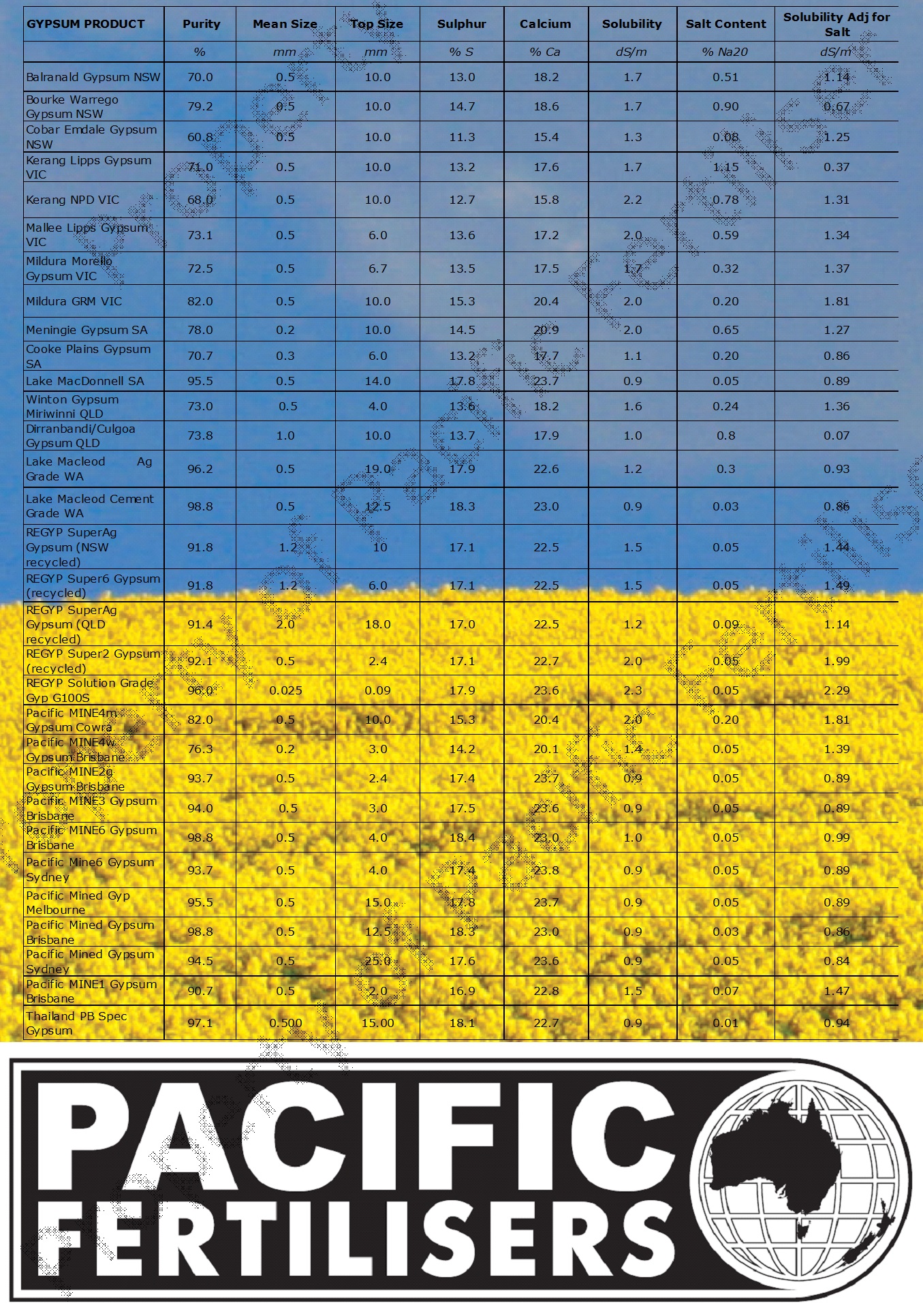
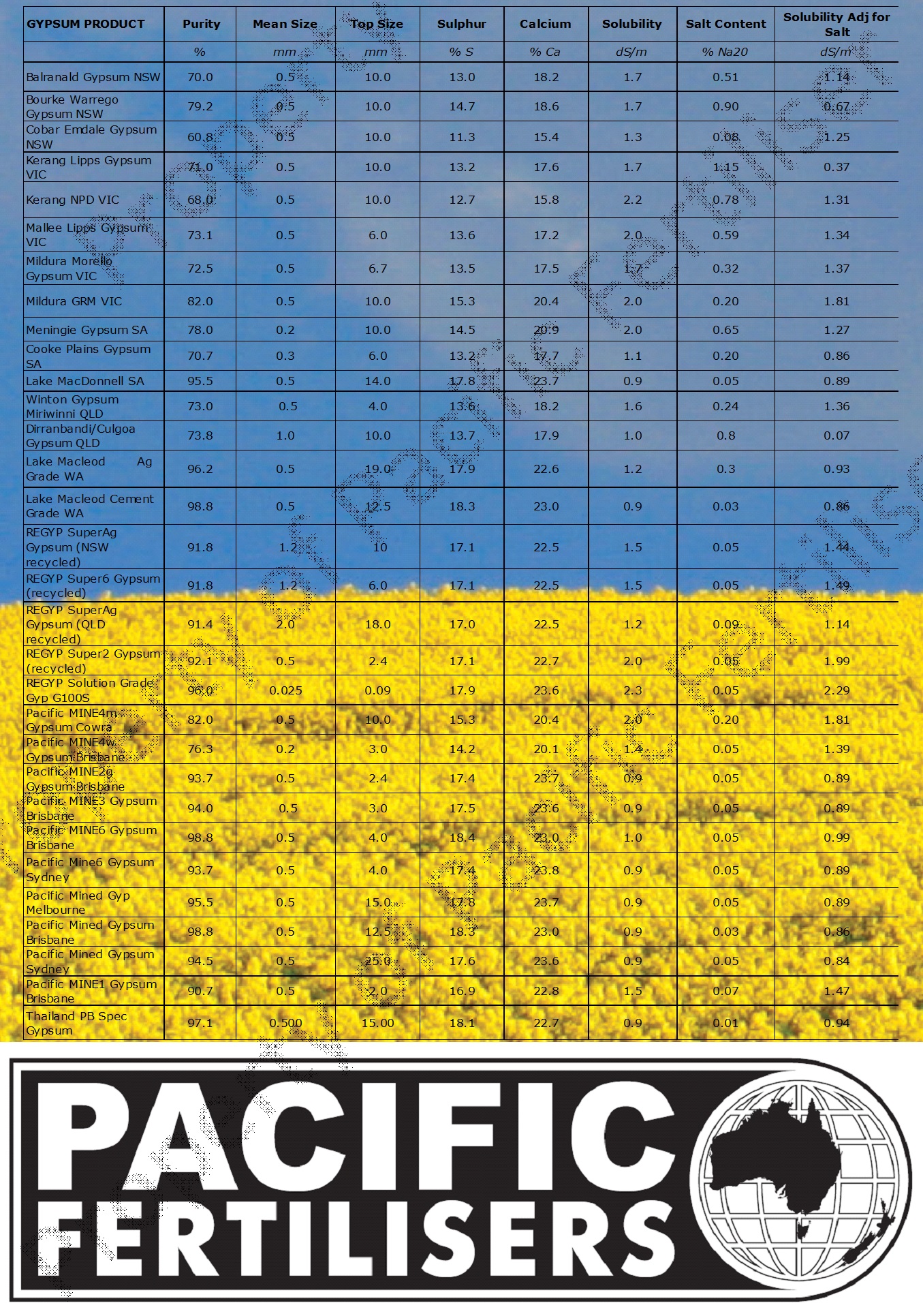
    Pacific Fertiliser recently added more gypsum pits to a study it undertook in 2015 for detailed research into the bulk agricultural gypsum products available on the eastern seaboard of Australia. This research continues on from the NSW Department of Primary Industries work in 1996 which was reported in the AgFact AC.10 (Agdex 514) document.

    The numerous gypsum samples were obtained from various agricultural gypsum sources either ex mine pit or from product landed on the farm. Pacific Fertiliser natural gypsum and REGYP recycled gypsum products were tested during the research and these were taken from our finished product stockpiles.

    The main items we tested for were gypsum purity, sizing and solubility. The results enable us to benchmark our products against others, but also to help customers in their evaluation of which gypsum to use when they are looking to purchase gypsum for their farm or project.

    When testing for gypsum solubility, we employed the method used in the AgFact AC.10 paper. This test method is more indicative of what happens in the paddock rather than the normal method to test solubility, where gypsum samples are finely ground up before being analysed. Due to the river bed gypsum having higher salt contents we had to adjust the solubility results to reflect the true gypsum solubility.

    If you have any questions or would like to view the full report please feel free to call 1300473497 or visit our website www.pacificfertiliser.com 

    Test Laboratory:
    Pacific Fertiliser commissioned Cement Australia to do the gypsum analysis work in 2015 through to 2017 for our research. Cement Australia’s laboratory in Darra QLD is NATA approved and very proficient and experienced in testing gypsum and other minerals.

    Test Methods:
    Gypsum Purity:-                      Calculated from Sulphur (S) content. (18.6% Sulphur is 100% CaSO4.2H2O)
    Sulphur Content: –                  X-ray fluorescence (XRF)
    Total Calcium:-                         XRF
    Total Oxides:-                            XRF
    Moisture Content:-                 AS 4489.8.1, modified for gypsum by limiting heat to 40ºC for 24 hrs.
    Particle Size:-                             Analysis Dry sieve
    Gypsum Solubility:-                As per the method used in the NSW AGFACTS AC.10. Solubility is expressed as electrical conductivity (EC) of solution obtained by adding the equivalent of 10g of pure gypsum (CaSO4.2H2O) to 1 litre of demineralised water. This solution is gently shaken (20 times end over end) and placed in a centrifuge for 10 minutes. The unit of electrical conductivity is dS/m.
    Adjusted solubility:-                Pacific Fertiliser added a modified column to the analysis results in the above table, to allow for the effect on electrical conductivity in the gypsum samples with a higher salt content. The measured electrical conductivity (EC) of a solution is influenced by the concentration and composition of dissolved salts.  In the 1996 results Bourke solubility was 0.4 dS/m and Balranald was 1.0 dS/m.

    Please download a full copy of the research report here (17mB)


  • New Processing Equipment

    New Processing Equipment

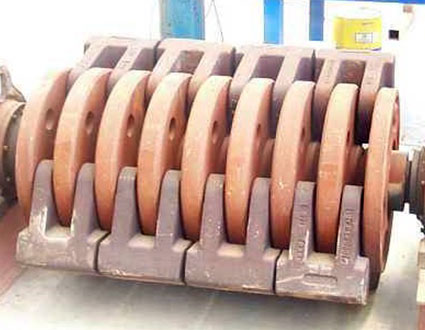
    Pacific Fertiliser has purchased a new 150kW hammermill which we will install in our system, for processing gypsum, lime, soft rock phosphate and dolomite at our Brisbane plant.

    The hammermill will be in series with jaw and cone crushers to produce a fine ground product for agricultural applications.

    Hammermill Hammermill

  • THE IMPORTANCE OF SOLUBILITY IN SOIL CONDITIONERS

    THE IMPORTANCE OF SOLUBILITY IN SOIL CONDITIONERS

    Solubility in soil conditioners, such as gypsum, lime and dolomite are very important.  The key to solubility is mainly in particle size.  The finer the product, whether it be in gypsum, lime, dolomite or any other natural occurring mineral the quicker the result.

    Natural raw gypsum, aglime and dolomite should be applied at least six months before cropping to achieve worthwhile results. Products such as Mine2g gypsum which have a mean particle size below 0.5mm and 99% passing 2mm mesh will have a high solubility compared to standard natural gypsum.

    Recycled gypsum, superfine lime and dolomite however are a different story.  Recycled gypsum from plaster board has been refined to very small particles in the production of the plaster board, making it far more soluble than raw gypsum, in other words, you can apply it just before cropping and get a good result.

    In the case of Superfine lime and dolomite against aglime, you will achieve a much quicker response.  The smaller particles are the secret to quicker results and of course higher yielding crops.

    Soluble gypsum Q&A document


    Bulk Lime

  • QLD Gypsum Products

    QLD Gypsum Products

    Pacific Fertiliser supplies numerous gypsum products into the QLD market.

    The gypsum products include:
    – QLD Mined gypsum
    – QLD Screened mined gypsum
    – QLD Milled gypsum
    – QLD superflocc gypsum
    – QLD Prilled gypsum & QLD Granulated gypsum
    – QLD gypsum blends (with products like phosphate, lime, elemental sulphur etc)
    – QLD Recycled gypsum

    Pacific Fertiliser supplies gypsum to the QLD market for agricultural, mining and civil engineering applications. The gypsum products are available in bulk and bag.

    gypsum

    Pacificfertiliser

  • ULTRA-GYP

    Pacific Fertiliser releases ULTRA-GYP which is made from ultra fine mined gypsum. ULTRA-GYP can be suitable for  flocculation and aerial applications in industrial, agricultural and civil operations.

    The ground gypsum can be mixed with water and applied via irrigation, spread aerially, or added to dams for flocculation (to reduce water turbidity).

    It has a mean particle size of <35um making it an ultra fine grade gypsum.

    Wheat