Tag: tresspass fertiliser

  • TriplePlus Fertiliser Benefits

    TriplePlus Fertiliser Benefits

    Triple Plus (aka Trespass or TSPS) Fertiliser Benefits

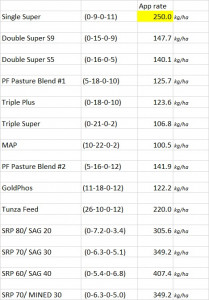
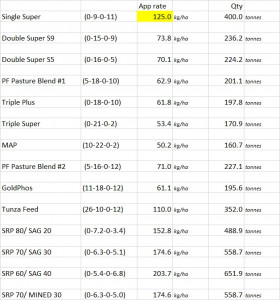
    62t TriplePlus contains the same amount of phosphate as 125t Single Super (SSP).

    (62t TriplePlus (0-18-0-10) contains [62 x (17.8/ 100)] = 11t phosphorus (P);
    and
    125t SSP (0-9-0-11) contains [125 x (8.8/100)] = 11t phosphorus (P).

    The product is very suited to aerial or ground spread applications over hilly country where application rates and frequency are generally low. On top of allowing you to purchase less fertiliser, you could potentially reduce your handling and spreading costs by up to 50% by using the TriplePlus fertiliser product over single super.

    The downside is triple super and triple plus are not the most available sources of phosphorous and in Triple Plus fertiliser the sulphur is mainly elemental.


  • Triple Plus Fertiliser

    Triple Plus Fertiliser

    [fusion_builder_container type=”flex” hundred_percent=”no” equal_height_columns=”no” menu_anchor=”” hide_on_mobile=”small-visibility,medium-visibility,large-visibility” class=”” id=”” background_color=”” background_image=”” background_position=”center center” background_repeat=”no-repeat” fade=”no” background_parallax=”none” parallax_speed=”0.3″ video_mp4=”” video_webm=”” video_ogv=”” video_url=”” video_aspect_ratio=”16:9″ video_loop=”yes” video_mute=”yes” overlay_color=”” video_preview_image=”” border_color=”” border_style=”solid” padding_top=”” padding_bottom=”” padding_left=”” padding_right=””][fusion_builder_row][fusion_builder_column type=”1_1″ layout=”1_1″ background_position=”left top” background_color=”” border_color=”” border_style=”solid” border_position=”all” spacing=”yes” background_image=”” background_repeat=”no-repeat” padding_top=”” padding_right=”” padding_bottom=”” padding_left=”” margin_top=”0px” margin_bottom=”0px” class=”” id=”” animation_type=”” animation_speed=”0.3″ animation_direction=”left” hide_on_mobile=”small-visibility,medium-visibility,large-visibility” center_content=”no” last=”true” min_height=”” hover_type=”none” link=”” border_sizes_top=”” border_sizes_bottom=”” border_sizes_left=”” border_sizes_right=”” first=”true”][fusion_text]

    TriplePlus Fertiliser (aka Tresspass fertiliser)

    Is a compound fertiliser of Triple super phosphate and mircofine sulphur (TSPS fertiliser).  The TSPS product contains 10% S (mainly elemental sulphur) within the fertiliser granule.

    Available in Australia as a standard 0-16-0-7   and is being well received in the eastern ranges pastoral country as a high analysis phosphorous source.

    It can be blended with extra sulphur to achieve the same P:S ratio as single super, by blending an extra 11% sulphur bentonite to give 0-16-0-20

    [/fusion_text][/fusion_builder_column][/fusion_builder_row][/fusion_builder_container]

  • Triple Super Alternatives

    Triple Super Alternatives

    Triple Superphosphate (TSP) product is no longer stocked in large volumes in Australia and TSP is mainly used in blends.

    The products that are being used in its place are TriplePlus/Tresspass fertiliser  (TSPS), Double Super Phosphate (DSP or PastureKing), Monoammonium phosphate (MAP) and Single superphosphate (SSP).

    Triple superphosphate, while not chemically pure, can be thought of as monocalcium phosphate (MCP), which has the formula Ca(H2PO4)2.H2O.

    Single superphosphate is comprised of approximately two-thirds gypsum (CaSO4.2H2O) and one-third  MCP.

    The chemical formula for MAP is NH4H2PO4

    MCP and MAP both dissociate to release H2PO4+ ions, so in this respect there is no difference in the products.

    MAP and MCP vary in their solubility in water:

    • MAP        37 kg/100 L
    • MCP        2 kg/100L.

    The gypsum in single superphosphate (SSP) makes this product less soluble and more difficult to dissolve. Gypsum has a solubility of 0.26 kg/100 L, about one-eight of that for MCP.  Gypsum also has no effect on soil pH.

    The solubility of gypsum is comparable to that of Burnt and Hydrated Lime, and is much higher than that of ground limestone:

    • Calcium Carbonate                 (Lime)                                             CaCO3            0.0013 kg/100 L
    • Calcium Oxide                          (Burnt or Quick Lime)                CaO                0.13 kg/100L
    • Calcium Hydroxide                 (Slaked or Hydrated Lime)        Ca(OH)2           0.17 kg/100 L

    Super Spreading


    Superphosphate SSP (8.8% P)
    This is produced by treating rock phosphate with sulfuric acid, and is the most commonly used phosphorus fertiliser.

    Double superphosphate DSP (17.5% P with 5% S)
    Phosphoric acid is used instead of sulfuric acid in manufacture.

    Triple Super Sulphur  TSPS (18% P) with 10% S)
    Compound granule of triple super and elemental sulphur.

    Triple superphosphate TSP  (20% P)
    Phosphoric acid is used instead of sulfuric acid in manufacture.

    Monoammonium phosphate (MAP 21% P); Diammonium phosphate (DAP 20% P)
    These two fertilisers are produced by treating phosphoric acid with ammonia.

    Rock phosphate (10% P)
    Crushed & mill soft rock phosphate is sometimes used as a fertiliser but is very insoluble. Reactive phosphate rock (RPR) can be more soluble than crushed rock phosphate where there is acid soil/sulphur.