

Tag: Powder gypsum

  • Gypsum Quality Comparison Report 2017

    Gypsum Quality Comparison Report 2017

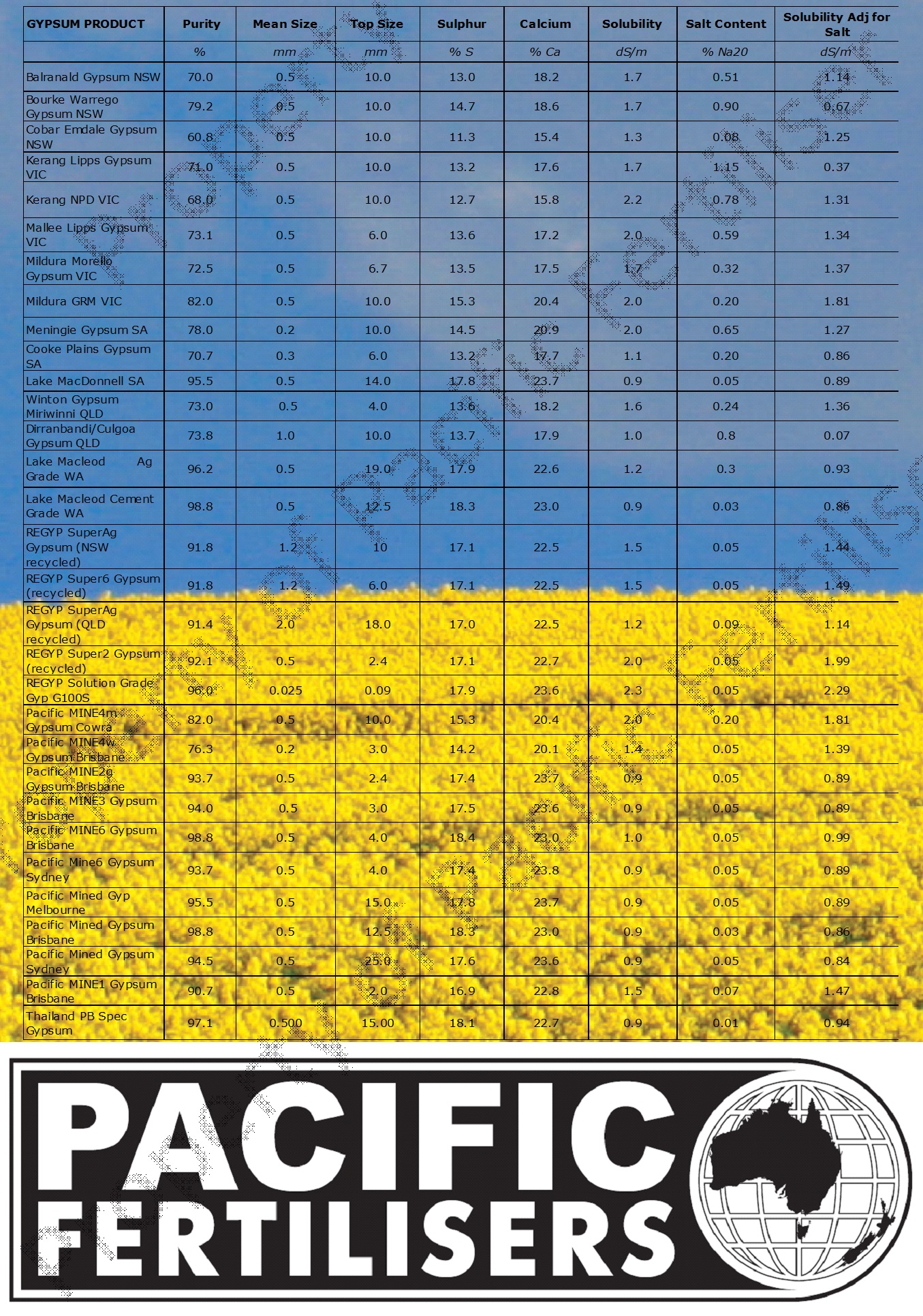
    Pacific Fertiliser recently added more gypsum pits to a study it undertook in 2015 for detailed research into the bulk agricultural gypsum products available on the eastern seaboard of Australia. This research continues on from the NSW Department of Primary Industries work in 1996 which was reported in the AgFact AC.10 (Agdex 514) document.

    The numerous gypsum samples were obtained from various agricultural gypsum sources either ex mine pit or from product landed on the farm. Pacific Fertiliser natural gypsum and REGYP recycled gypsum products were tested during the research and these were taken from our finished product stockpiles.

    The main items we tested for were gypsum purity, sizing and solubility. The results enable us to benchmark our products against others, but also to help customers in their evaluation of which gypsum to use when they are looking to purchase gypsum for their farm or project.

    When testing for gypsum solubility, we employed the method used in the AgFact AC.10 paper. This test method is more indicative of what happens in the paddock rather than the normal method to test solubility, where gypsum samples are finely ground up before being analysed. Due to the river bed gypsum having higher salt contents we had to adjust the solubility results to reflect the true gypsum solubility.

    If you have any questions or would like to view the full report please feel free to call 1300473497 or visit our website www.pacificfertiliser.com 

    Test Laboratory:
    Pacific Fertiliser commissioned Cement Australia to do the gypsum analysis work in 2015 through to 2017 for our research. Cement Australia’s laboratory in Darra QLD is NATA approved and very proficient and experienced in testing gypsum and other minerals.

    Test Methods:
    Gypsum Purity:-                      Calculated from Sulphur (S) content. (18.6% Sulphur is 100% CaSO4.2H2O)
    Sulphur Content: –                  X-ray fluorescence (XRF)
    Total Calcium:-                         XRF
    Total Oxides:-                            XRF
    Moisture Content:-                 AS 4489.8.1, modified for gypsum by limiting heat to 40ºC for 24 hrs.
    Particle Size:-                             Analysis Dry sieve
    Gypsum Solubility:-                As per the method used in the NSW AGFACTS AC.10. Solubility is expressed as electrical conductivity (EC) of solution obtained by adding the equivalent of 10g of pure gypsum (CaSO4.2H2O) to 1 litre of demineralised water. This solution is gently shaken (20 times end over end) and placed in a centrifuge for 10 minutes. The unit of electrical conductivity is dS/m.
    Adjusted solubility:-                Pacific Fertiliser added a modified column to the analysis results in the above table, to allow for the effect on electrical conductivity in the gypsum samples with a higher salt content. The measured electrical conductivity (EC) of a solution is influenced by the concentration and composition of dissolved salts.  In the 1996 results Bourke solubility was 0.4 dS/m and Balranald was 1.0 dS/m.

    Please download a full copy of the research report here (17mB)


  • GYP-MAG

    Pacific Fertiliser releases a new prilled product of 95% Gypsum and 5% Magnesium.

    This product is a great source of calcium, sulphur and magnesium.

    The 2 – 4mm prilled product increases flowability, bulk density and minimises dust during handling and  spreading

    General Product Specifications:
    • Calcium Ca – 21+%
    • Sulphur S – 17.4+%
    • Magnesium MG – 0.5+%
    • Gypsum Purity CaSO4 2H2O – 85+%
    • Magnesium Sulfate Heptahydrate – 4.9+ %
    • Free Moisture – < 0.3 %
    • Packaging – Available in 1 tonne bulk bags or pallets of 40x 25kg bags


    IMG_00007773

    The benefits of GYP-MAG include
    • Increase movable calcium, sulfur, and magnesium ions in soil
    • Promote Nitrogen Fixation and increase the efficient use of nitrogen in plant roots
    • Support Chlorophylls formation and photosynthesis
    • Strengthen the nutrient balance between calcium and other micronutrients
    • Correct soil surface crusting. This will enable good water penetration and improve the water and air movement in the soil.
    • Help soil for easy and rapid plowing
    • Enhance the development of soil organic matter
    • Maintain good soil moisture management
    • Buffer to appropriate soil pH
    • Increase the efficiency of water and nutrient absorption in plant
    • Reduce water runoff and soil erosion
    • Prevent diseases which affect stem root, fruit rots, crack stem and fruit diseases
    • Easily applied by granular mixing and hand or machine spreading, solely or together with any primary fertilizer