Author: admin

  • REMAP Blend

    PacFert releases a new blended product called REMAP. A blend containing Urea, DAP, Rock Phosphate, Lime and Gypsum. REMAP has good levels of N, P, K, S and Ca.

    Which provides you with a good base of soil nutrients in a single low cost application.

    PRODUCT Nitrogen (N) Phosphorous (P) Potassium (K) Sulphur (S)
    Calcium (Ca)
    % w/w % w/w % w/w % w/w % w/w
    REMAP 18+ 2+ 1+ 1.5% 6+


  • QLD Projects using Gypsum

    QLD Projects using Gypsum

    Pacific Fertiliser supplies high quality gypsum & lime into the majority of the major QLD mining projects due to the superior quality of its products and reliability of delivery. Some application include stabilisation, rehabiliation, flocculation and water treatment.

    dampier

    Coal Projects
    Wandoan Juandah Metrocoal $10M
    Chinchilla Glen Wilga Coal Mine Tarong Energy $500M
    Kogan Kogan Creek Mine CS Energy $1.2B
    Wandoan Norwood Creek Project Metrocoal
    Wandoan Wandoan Coal Project Xstrata Coal $6.8B
    Macalister Wilkie Creek Expansion Project Peabody Energy $162M
    Wandoan Woori Creek Project Surat Coal Pty Ltd / Cockatoo Coal
    Miles Columboola Joint Venture Project Metrocoal / Sinocoal Resources $4M
    Wandoan Bundi Coal Mine Metrocoal
    Cameby Cameby Downs Mine Yancoal $190M
    Cameby Cameby Downs Expansion Project Yancoal
    Wandoan Elimatta Project Taroom Coal Pty Ltd / North Energy Corporation (NEC) $600M
    Wandoan The Range Stanmore Coal $500m

    CSG Projects
    Chinchilla Queensland Curtis LNG Pipeline QGC / BG Group $15B
    Chinchilla – Arrow Surat Pipeline $550M
    Chinchilla Ironbark Project Origin $1.5B
    Wandoan – Dalby Surat Basin Gas Project Arrow Energy $1.5B +
    Yuleba North – Reedy Creek, Combabula & Eurombah Creek
    Condabri Central – Condabri & Orana


    CSG Pipeline Projects
    Chinchilla Kenya – Goodiwindi Pipeline Project ERM Power
    Chinchilla Queensland Curtis LNG Pipeline QGC / BG Group $15B
    Kogan / Chinchilla Surat Pipeline Project Arrow Energy $550M
    Wallumbilla – Chinchilla Australia Pacific LNG Origin $500M

    LNG Projects
    Chinchilla Chinchilla LNG Plant QGC / BOC

    Power Station Projects
    Wandoan Wandoan Power Project GE Energy / Xstrata
    Kogan Western Downs to Halys Transmission Project Powerlink
    Kogan Braemar 1 ERM Power $545M
    Kogan Braemar 2 ERM Power / Arrow Energy $546M
    Kogan Braemar 3 ERM Power $550M
    Cameby Columboola – Westerns Downs Powerlink
    Condamine Condamine Power Station QGC $200M
    Dalby Darling Downs Power Station Origin $1.3B
    Dalby Daandine Power Station Arrow Energy

    Solar Projects
    Wandoan Methane Joint Venture Project Cougar Energy $110M
    Kogan Bloodwood Creek Carbon Energy $36M
    Condamine Andrew Project and Lauren Project Liberty Resources
    Chinchilla UCG – GTL Project Linc Energy $1.2B

    Rail Projects
    Wandoan Southern Missing Link Surat Basin Rail Pty Ltd $1B

  • Reducing Soil Acidity

    Reducing Soil Acidity

    Dolomite and AG lime are the only natural products that will decrease your soils acidity thereby rectifying the problem. Dolomite is valued for its magnesium content and it is this, which distinguishes it from limestone. Dolomite and Ag lime (limestone) both neutralise soil acidity but only dolomite can correct magnesium deficiencies in the soil. Magnesium, like calcium is a plant nutrient.
    Over time the acidity of soil tends to increase. This is due to such varied sources as rainwater (containing dissolved carbon dioxide), pollution containing oxides, sulphur and nitrogen, using fertilizers rich in ammonia, plant roots exuding nitrogen ions, and the natural decomposition of organic matter. Substantial research has been done on the optimal pH range for various crops. Dolomite has long been used to lower the acidity and raise the pH of farmlands and grass lawns.

    Each time a field is farmed, whether it is for crop or pasture, the soil naturally increases in acidity. (pH 5.5 -strongly acidic – <4.5 extremely acidic). This acidity stops plants from absorbing the minerals required for growth and reduces the availability of naturally occurring nutrients to the crop. High rainfall areas have naturally acidic soils; however in some areas soil acidification can be a slow process resulting in a gradual and often unnoticed drop in production. Farmers should aim to feed the soil, not the plant, to create a soil that is balanced in nutrients, has good structure, high biological activity and high levels of organic matter. The soil pH should be constantly monitored and treated regularly with Lime or Dolomite.

    products_lime

    products_dolomite

  • Lime

    Lime

    Pacific Fertiliser sells many forms of Ag Lime (limestone) such as ground ag lime, prilled ag lime, fine ag lime and ultra fine ag lime. We also sell carbide lime, quick lime and hydrated lime.

    These products are available mainly from Brisbane, Sydney and Cowra, but we also have many region locations which enable us to offer competitive delivered rates.

    galong lime

  • Treating Salinity and Sodic soil with Gypsum

    Treating Salinity and Sodic soil with Gypsum

    Treating Salinity and Sodic soil with Gypsum

    Most of the croplands in Australia are currently affected to some degree by saline or sodic soils. As salinity increases, crop yields and resistance to disease decreases.

    A sodic soil has an exchangeable sodium percentage (ESP) of more than 6. This means that sodium comprises more than 6% of the total exchangeable cations in the soil. Sodic soils are likely to disperse, that is, break down into individual clay particles that block pore spaces. This dispersion causes poor water infiltration, slow internal drainage, surface crusting and germination problems. If dispersion occurs in the subsoil, the soil may become almost impermeable and be a poor environment for growing plants (except rice).

    The use of saline water may reduce the level of dispersion in the short term due to flocculation of the clay particles. If the rate of leaching is inadequate, the sodium accumulates in the soil, making it more sodic and more difficult to manage. Unlike salinity, sodicity in soils is virtually permanent, in nature: the only way to reverse it is to apply gypsum. Reduced tillage and a build-up of organic matter can reduce the degree of dispersion in a sodic oil, but will not alter the soil’s ESP.

  • Potassium Sulphate

    [fusion_builder_container hundred_percent=”no” equal_height_columns=”no” hide_on_mobile=”small-visibility,medium-visibility,large-visibility” background_position=”center center” background_repeat=”no-repeat” fade=”no” background_parallax=”none” parallax_speed=”0.3″ video_aspect_ratio=”16:9″ video_loop=”yes” video_mute=”yes” border_style=”solid” flex_column_spacing=”0px” type=”legacy”][fusion_builder_row][fusion_builder_column type=”1_1″ type=”1_1″ background_position=”left top” background_color=”” border_color=”” border_style=”solid” border_position=”all” spacing=”yes” background_image=”” background_repeat=”no-repeat” padding_top=”” padding_right=”” padding_bottom=”” padding_left=”” margin_top=”0px” margin_bottom=”0px” class=”” id=”” animation_type=”” animation_speed=”0.3″ animation_direction=”left” hide_on_mobile=”small-visibility,medium-visibility,large-visibility” center_content=”no” last=”true” min_height=”” hover_type=”none” link=”” first=”true”][fusion_text]

    Potassium Sulphate or Sulphate of Potassium (SOP) provides both potassium and sulphur in soluble forms.

    Potassium Sulphate (0-0-41-18) contains no chloride and is the recommended form of potassium where soils are saline or sodic and where irrigation water may have high chloride levels.

    Potassium stimulates the growth of strong stems and gives the plant some disease resistance by promoting thickness of the outer cell walls. Adequate potassium can reduce moisture loss from growing plants, thereby giving some drought resistance. Potassium improves colour, flavour and storing quality of fruit and vegetables.
    Potassium sulphate (SOP) can be a more expensive source of potassium than MOP and so its uses are often restricted to five main areas. Where soil or irrigation water salt levels are high and Muriate of Potash (MOP) is undesirable. Where chloride sensitive crops are being grown; for example, berries and vines. Where high chloride levels occur in irrigation water.

    Pacific Fertiliser sells Sulphate of Potassium in bulk loads, 1 tonne bulk bags and pallets of 25 kg bags.

    rolling

    Potassium sulphate comes under potash group with others being potassium chloride, nitrate of potash, and other salts of potassium. Presently, it has the lowest consumption share among other group of competing fertilizers like Nitrogen and Phosphates.

    Potassium sulphate is the most popular chloride free fertilizer utilized among group of potash fertilizers. Its quality properties and characteristics such as resistance to draught, low salt index, suitability for chloride sensitive crops and saline soil make it highly preferred fertilizer among chloride free fertilizers.

    Presently the global production capacity is around 6.5 million tons. Most of the potassium sulphate is utilized for fertilizer application and is produced in various forms such as standard grade, granular grade, or powder (water soluble) grade. Mannheim is the widely used production process globally for manufacturing of SOP. Countries with high agricultural production, population growth, and arable land are the predominant consumers of potassium sulphate fertilizers and import huge quantities of the same.

    [/fusion_text][/fusion_builder_column][/fusion_builder_row][/fusion_builder_container]

  • AGG Lime

    AGG Lime

    Agg lime or calcium carbonate is more commonly referred to as Ag Lime.

    For more information on our lime products please see the following Lime Products Page


  • Thai Gypsum

    Pacific Fertiliser has performed a trial with Thai mined gypsum and has had some good results in milling the product to a fine powder for various applications.

    The product looks good and will be available ex Sydney and Melbourne.

    Note:- Pacific Fertiliser prefers to sell gypsum mined in Australia.

    IMG_00008168

  • BENEFITS OF PHOSPHATE ROCK APPLICATION

    BENEFITS OF PHOSPHATE ROCK APPLICATION

    BENEFITS OF DIRECT APPLICATION PHOSPHATE ROCK

    Organic farming is the fastest growing sector of the global economy. Australia is the largest organic producer globally with 12 million hectares under organic cultivation. Pacific Fertiliser’s organic phosphate fertiliser is environmentally and nutritionally superior to chemical fertilisers and can be used on a wide variety of crops and pastures.

    Organic fertilisers based on rock phosphate such as PacFerts’s products offer several advantages over chemically processed soluble fertilisers such as superphosphate.

    • Organic fertilisers slowly release nutrients into the soil matching the speed at which the nutrients are being absorbed by the plants.

    • Phosphate rock has the ability to restore microelemental and microbial soil balance which in turn leads to less reliance on artificial fertilisers and better crop yields.

    • Use of organic phosphate instead of chemically processed phosphate avoids the serious environmental degradation caused by increased concentrations of fertilisers in the ground water, the rivers and the coastal waters. Use of organic phosphate rock reduces the risk of harmful accumulation of nutrients in the soil and reduces soil salinity problems

    • Plants grown on organic phosphate rock fertiliser have a better nutritional quality.

    • Because of phosphate rock’s unique chemical composition, incorporation of phosphate rock into the soil enhances its biological activity and increases soil carbon (C) accumulation, leading to improved soil fertility and restoration of its physical and chemical properties.

    • Organic phosphate rock is a source of several nutrients other than P. Rock phosphates are usually applied to replenish soil P status, but phosphate rock also provides other nutrients not present in soluble fertilisers. Application of organic phosphate has a potential trigger effect on plant growth and crop yields as a result not only of phosphorus release but also because of phosphate rock’s effect on increasing exchangeable calcium (Ca) and reducing aluminium saturation.

    • Phosphate rocks for direct application can be more efficient than artificial fertilizers in terms of phosphorus (P) recovery by pants under certain conditions. Based on the unit cost of P, natural phosphate rock is usually the cheapest.

    • Phosphate rocks are natural minerals requiring no metallurgical processing. Their direct application avoids production of polluting wastes such as phosphor-gypsum and greenhouse gases, thus resulting in energy conservation and protein environment.

    Pacific Fertiliser also produces other organic compliant natural mineral fertilisers and soil conditioners.

    products_phosphate_rock

    Note: Soft Rock Phosphate does not contain soluble phosphate, therefore the phosphate availability is a function of acid soil conditions and/or active soil biology, i.e. soft rock phosphate becomes available rapidly in acidic soils. In alkaline soils, it should be combined with REGYP compost, humates, microbial agents. Application rates are generally in the range of 500kg to 1500kg per hectare (Ha).

    Phosphate Rock

  • Aerial Grade Phosphate Rock

    Aerial Grade Phosphate Rock

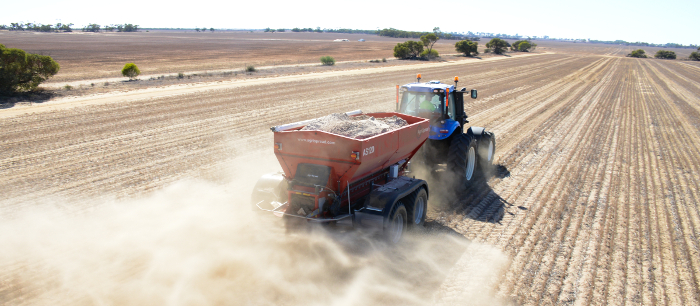
    Pacific Fertiliser’s aerial grade phosphate rock  RPR210 is a granular 2-10mm product that will be available in 2014.

    The product provides minimal dust and very flowable properties, suitable for aerial applications.

    The phosphorous is then released into the soil over a few years providing good long term returns with minimal applications when applied correctly.

    PacFert can also blend this with prilled gypsum and/or prilled lime for a one pass application.


    Superspread10_Aerial_ Spreading 4